How to Request a Custom Packaging Quote: A Complete RFQ Checklist
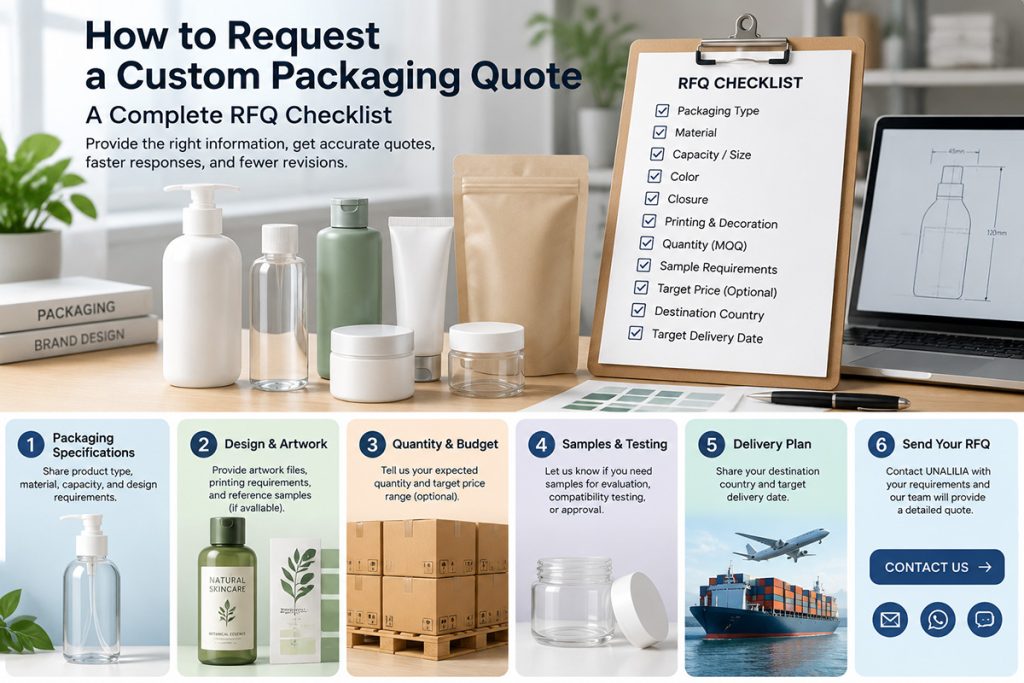
Requesting a custom packaging quote is an important step when sourcing packaging for a new product or expanding an existing product line. Whether you need plastic bottles, cosmetic jars, pumps, flexible pouches, or custom printed labels, providing accurate specifications helps your packaging supplier evaluate your requirements and prepare a more relevant quotation.
However, many packaging inquiries begin with only a product name or reference image. Without information about size, material, quantity, printing, and intended application, it can be difficult to compare quotations accurately.
In this guide, we explain how to request a custom packaging quote, what information to prepare, and how to make your packaging sourcing process more efficient.
What Is an RFQ in Packaging?
RFQ stands for Request for Quotation. It is a request sent to a supplier asking for pricing and relevant purchasing information based on specified product requirements.
A packaging RFQ typically includes:
- Packaging type and application
- Material and dimensions
- Capacity or fill volume
- Color and customization requirements
- Printing artwork or decoration details
- Order quantity
- Required accessories or closures
- Destination country and delivery expectations
The more complete your specifications are, the easier it is for a supplier to evaluate the project and identify suitable packaging options.
1. Identify the Type of Packaging You Need
Start by explaining what kind of packaging you are looking for.
Common packaging categories include:
- Plastic Bottles: PET, HDPE, PP, PETG, and other suitable bottle options.
- Plastic Jars: Containers for creams, balms, powders, supplements, and other products.
- Caps and Closures: Screw caps, flip top caps, disc top caps, and other closure options.
- Pumps and Sprayers: Lotion pumps, fine mist sprayers, trigger sprayers, and dispensing systems.
- Flexible Packaging: Stand-up pouches, spout pouches, flat bottom bags, and roll stock film.
- Labels and Stickers: Custom printed labels for bottles, jars, pouches, and other containers.
If you are unsure which packaging format is best, describe your product and how customers will use it. Your supplier can then discuss suitable options.
2. Provide the Product Application
The product inside the package affects material selection, closure compatibility, barrier requirements, and dispensing performance.
For example, a shampoo bottle may require a lotion pump or flip top cap, while a facial serum may be better suited to a dropper bottle or another controlled dispensing system.
When requesting a quotation, explain:
- What product will be packaged
- Whether it is a liquid, cream, gel, powder, or solid
- Its approximate viscosity, if relevant
- Any special compatibility or protection requirements
- How the product will be filled, stored, and used
For sensitive formulas or household chemical products, compatibility testing may be necessary before confirming the final packaging specification.
3. Confirm the Size and Capacity
Packaging dimensions and capacity are essential quotation details.
For bottles and jars, specify the required fill volume, such as 100 ml, 250 ml, or 500 ml. If you have a preferred model, include its dimensions or product reference.
For flexible packaging, provide the pouch width, height, bottom gusset, and other relevant dimensions.
Keep in mind that fill volume and external dimensions are not interchangeable. Two pouches with the same dimensions may hold different quantities depending on the product’s density, shape, and required headspace.
If you do not know the correct size, provide your target fill quantity and product details so suitable dimensions can be evaluated.
4. Specify the Packaging Material
Material selection influences product protection, appearance, durability, manufacturing requirements, and cost.
Common options for rigid plastic packaging include:
- PET: Often selected for clear bottles and containers.
- HDPE: Commonly used for durable bottles for personal care and household products.
- PP: Used in jars, caps, closures, and other packaging components.
- PETG: Considered for certain cosmetic and personal care packaging designs.
Flexible packaging may use different film structures depending on the required moisture barrier, oxygen barrier, sealing performance, puncture resistance, and product shelf life.
If you do not have a confirmed material specification, explain the application and required performance rather than choosing a material based on price alone.
5. Include the Closure and Accessories
A bottle or jar quotation should clearly identify the required cap, pump, sprayer, or other closure.
Common options include:
- Lotion pumps
- Fine mist sprayers
- Trigger sprayers
- Flip top caps
- Disc top caps
- Screw caps
- Droppers
For bottles with threaded necks, provide the complete neck finish specification when known, such as 20/410, 24/410, or 28/410.
Matching the nominal neck finish is an important starting point, but the complete bottle and closure should still be checked for fit, sealing, dispensing performance, and formula compatibility.
6. Explain Your Customization Requirements
Custom packaging can be adapted to your brand identity through colors, printing, labels, and other decoration methods.
When requesting a quotation, specify whether you need:
- Standard or custom packaging colors
- Screen printing
- Hot stamping
- Custom printed labels or stickers
- Matte or glossy finishes
- Custom pouch printing
- Special shapes or new tooling
If possible, provide your brand artwork, reference images, color references, or technical drawings.
Using an existing packaging design with customized labels may be an alternative to developing a completely new container, depending on your project requirements.
7. Specify Your Order Quantity and MOQ Requirements
MOQ stands for Minimum Order Quantity. It refers to the minimum quantity a supplier can produce or sell under specified conditions.
Your quotation request should include the estimated order quantity and, if applicable, the quantity required for each color, size, or artwork design.
For example, if you need three bottle colors or five pouch designs, clarify whether the quantities are divided equally or vary by SKU.
Order quantity can influence production arrangements, printing methods, tooling costs, and unit pricing. Asking for quotations at several feasible quantities may help you compare purchasing options.
If you are still developing your product, mention your expected initial quantity and potential repeat-order demand. This can help the supplier discuss practical options for your launch.
8. Share Your Artwork and Reference Files
Reference files help suppliers understand what you want to produce.
Depending on the project, useful files may include:
- Product reference photos
- Packaging technical drawings
- Dimensions and specifications
- Logo files
- Print-ready artwork
- Color references
- Existing packaging samples
If you do not have final artwork, explain your intended design and branding requirements. The supplier can clarify which files are needed before printing or production begins.
9. Ask About Samples and Testing
Samples can help you evaluate packaging before committing to a larger order.
Depending on the project, you may want to review:
- Physical size and appearance
- Material and color
- Closure fit
- Pump or sprayer performance
- Leakage and sealing
- Printing quality
- Product compatibility
Tell your supplier whether you need standard samples, customized samples, or samples for formula compatibility testing.
Sample availability, charges, and preparation time should be confirmed for the specific project.
10. Provide Your Destination Country and Delivery Requirements
Packaging prices and delivery arrangements can depend on the destination, shipping method, order volume, and applicable trade terms.
Include the following information where possible:
- Destination country
- Delivery city or postal code, if required for freight estimates
- Target delivery date
- Preferred shipping method, if known
- Any special import or documentation requirements
Ask the supplier whether the quotation covers the packaging only or includes shipping and other charges.
Also confirm whether the stated lead time refers to production completion, dispatch, or final delivery.
11. Compare Packaging Quotations Fairly
When comparing multiple suppliers, make sure the quotations cover equivalent specifications.
A lower price may reflect a different material, closure, thickness, printing method, order quantity, or shipping arrangement.
Review the following factors:
- Product specifications
- Material and dimensions
- Included closures and accessories
- Printing and decoration
- MOQ and unit price
- Sampling and tooling charges
- Production lead time
- Shipping terms
- Quality requirements
For a meaningful comparison, ask suppliers to identify any assumptions or exclusions in their quotations.
Custom Packaging RFQ Checklist
Before submitting your inquiry, use this checklist to prepare the key information.
- Packaging Type: Bottle, jar, pouch, cap, pump, sprayer, label, or another product.
- Product Application: What will be packaged?
- Capacity or Dimensions: Required fill volume and size.
- Material: Preferred material or required performance.
- Closure: Pump, sprayer, cap, spout, zipper, or other feature.
- Color: Standard or custom color.
- Decoration: Printing, labels, or surface finish.
- Quantity: Total quantity and quantity per SKU.
- Artwork: Design files, logos, or reference images.
- Samples: Whether samples or testing are required.
- Destination: Country and delivery requirements.
- Target Timeline: Desired production or delivery date.
You do not need to know every technical detail before contacting a supplier. Start with the information you have and identify any specifications that still need confirmation.
Example: Custom Packaging Quote Request Email
Use the following example as a starting point for your own packaging inquiry.
Subject: RFQ for Custom Packaging
Hello UNALILIA Team,
We are looking for a packaging supplier for our upcoming product launch and would like to request a quotation.
- Product: [Product type]
- Packaging type: [Bottle, jar, pouch, or other]
- Capacity or dimensions: [Required size]
- Material: [Preferred material, if known]
- Closure or accessories: [Required components]
- Customization: [Color, printing, labels, or finish]
- Quantity: [Estimated quantity per design]
- Destination: [Country]
- Target delivery date: [Required timeline]
Please let us know the available options, MOQ, unit price, sampling arrangements, and estimated lead time.
We can provide reference images or artwork files if needed.
Thank you. We look forward to your quotation.
Best regards,
[Your Name]
[Company Name]
Custom Packaging Solutions from UNALILIA
UNALILIA provides packaging solutions for skincare, hair care, body care, cosmetics, household cleaning, food, supplements, and other applications.
Our product range includes:
- Plastic bottles
- Plastic jars
- Caps and closures
- Lotion pumps and sprayers
- Flexible packaging
- Labels and stickers
- Custom printing and decoration
Whether you need standard packaging with customized labels or a more specialized packaging configuration, share your requirements so suitable options can be evaluated.
Request a Custom Packaging Quote from UNALILIA
Planning a new product launch or looking for a packaging supplier?
Prepare your packaging type, product application, dimensions, material preferences, customization details, estimated quantity, and destination country.
If you do not have all the specifications yet, you can still contact us with your product details and reference images.
Contact UNALILIA today to discuss your packaging requirements and request a customized quotation.
Frequently Asked Questions About Custom Packaging Quotes
What information do I need to request a packaging quote?
Start with the packaging type, product application, capacity or dimensions, estimated quantity, customization requirements, and destination country. Material, closure, artwork, and testing details can be added when available.
Can I request a quote without knowing the exact packaging material?
Yes. Explain the product you are packaging and your performance requirements. A supplier can discuss potential material options, although the final specification may require sampling and compatibility testing.
Does requesting a quote require finalized artwork?
Not always. A preliminary quotation may be possible using reference images and basic specifications. Final printing and production requirements should be confirmed before the order is approved.
Why do packaging suppliers ask for quantity per design?
Different colors, sizes, and artwork versions can require separate production or printing arrangements. Quantity per design helps suppliers assess production feasibility and calculate pricing more accurately.
Should I request samples before placing a large order?
Samples are often useful for checking appearance, dimensions, closure compatibility, dispensing, and other requirements. The need for testing depends on the product and packaging application.
How can I get a more accurate packaging quotation?
Provide consistent specifications, clarify the quantity per SKU, share artwork or reference images, and confirm whether the price includes customization, accessories, tooling, and shipping.